Turkey’s combat drone achieved the first unmanned BVR kill in history
Turkey’s combat drone achieved the first unmanned BVR kill in history
Turkey has quickly become one of the world’s leading drone technology companies in recent years. However, Turkey’s state-of-the-art unmanned fighter aircraft program will lead the world’s first fighter-jet-level drone combat tests in 2025, marking a historic moment in military aviation. This incredible accomplishment has officially changed the course of aerial combat and astounded defense specialists throughout the globe.
Known as the Kızılelma (Red Apple), Turkey’s latest drone is more than just a UAV. Operating without a pilot, it is a genuine fighter jet that can carry out maneuvers, missions, and combat operations that were previously unattainable for human aircraft. The fact that this drone was able to effectively conduct aerial battles and live combat simulations during its early testing phases only serves to heighten the unbelievability of the narrative.
This article examines what makes Turkey’s fighter-jet drone so remarkable, how it attained unprecedented combat capabilities, and why experts believe it marks the start of a new era in international air warfare.
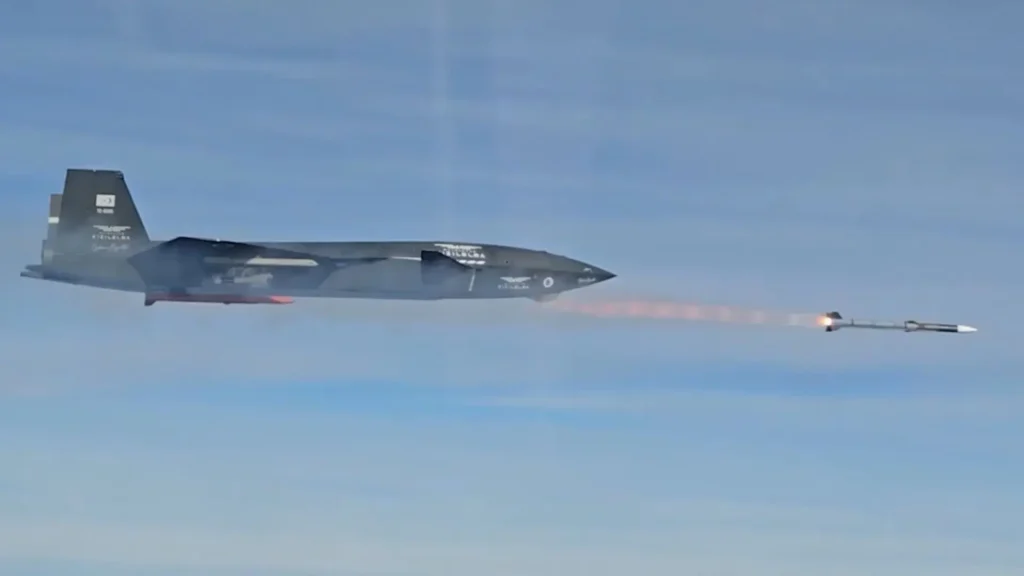
An Innovation in Aviation: What Is Turkey’s Fighter Jet Drone?
Under the direction of Baykar, the same firm that developed the well-known Bayraktar TB2 drone, Turkey has been working on an unmanned fighter jet project for many years. However, the new fighter drone is more superior.
Important Details on Turkey’s New Fighter Jet Drone
Design inspired by stealth
- Supersonic potential in next versions
- AI-powered autonomous warfare
- Capacity to depart from aircraft carriers
- sophisticated missile and radar systems
- High maneuverability with G-force
- Capable of dogfighting The AI
The new Turkish fighter jet drone is built for aggressive battle, long-range missions, and high-speed engagements, in contrast to conventional drones, which are sluggish, prop-driven, and intended for surveillance or accurate hits. With the exception of human limitations, it functions and seems like a next-generation combat aircraft.
The first-ever fighter jet drone combat simulation is an incredible accomplishment.
The most startling event occurred when Turkey carried out the first-ever combat simulation between human aircraft and fighter-jet drones. The unmanned jet showed the following during these tests:
Self-governing judgment in aerial combat
- Fast evasive moves
- Locking and tracking targets
- Missile engagement simulations
- AI-driven dogfighting techniques
These tests were referred to by defense insiders as “the moment the future arrived.” Unmanned fighter planes were expected to take over the skies for decades, according to military analysts. That forecast has now come to pass in Turkey.
The drone firing exercise was not the only aspect of the military test. Previously thought to be decades away, it included intricate aerial encounters in which the drone responded dynamically to threats in real time by modifying altitude, speed, angle, and assault tactics.
Why This Drone Is Not a UAV but Rather a Fighter Jet
Because to its sophisticated capabilities and aerodynamic design, Turkish fighter drones are frequently likened to fifth-generation aircraft. It resembles a pilotless fighter plane more than a drone for a number of reasons:
1. Fast Jet Power
This drone has a jet engine, which allows for far higher speed and altitude than other drones.
2. Covert Technology
Like contemporary stealth aircraft like the F-35 and F-22, its design reduces radar visibility.
3. Carrier Landing and Takeoff
It is intended to function from Turkey’s drone carrier ship, providing it with flexibility in naval air power.
4. Autonomy in Combat
AI responds more quickly than human pilots and handles many elements of flying and battle.
5. No Human Risk
Deep attacks, suppressing enemy air defenses, and aerial dogfighting—tasks that were previously too risky for human aircraft—can now be completed without endangering the lives of pilots.
How Modern Warfare Will Be Changed by Turkey’s Fighter Jet Drone
Turkey’s accomplishment is a strategic shift rather than merely a technological milestone.
1. Dogfights Without Pilots
An autonomous jet may now rival a manned aircraft for the first time. Faster, more aggressive air conflicts where computers exceed human responses are made possible by AI-driven fighting.
2. Significant Cost Benefits
It is significantly less expensive to build and run fighter drones than it is to sustain conventional air units. This might change the balance of power in the world and enable smaller countries to develop more sophisticated air warfare capabilities.
3. Using Swarm Techniques to Rule the Battlefield
With coordinated strikes, these drones may defeat opposing defenses either singly or in swarms.
4. Extended Journeys Without Fatigue
There are physical limitations for human pilots. Drones don’t. They are capable of conducting surveillance, deep attacks, and long-endurance missions for hours at a time.
5. High-Value, Risk-Free Missions
It is now possible to carry out risky operations without losing any lives, such as disabling radar stations, flying into disputed airspace, or neutralizing high-threat targets.
Worldwide Reaction: Surprise, Concern, and Shock
This breakthrough is being eagerly watched by nations all across the world. Defense specialists refer to it as:
“A change comparable to the development of the jet engine.”
“Unmanned air superiority’s inception”
“A technological breakthrough that will compel competitors to react.”
While some countries applaud Turkey’s technological advancements, others are concerned that fighter jet drones may start a new arms race. Whatever the response, one thing is certain: air warfare will never be the same.
In conclusion, a new era of fighter jets has emerged
An important milestone in the history of military aviation has been reached with Turkey’s first-ever fighter-jet-level drone combat. This drone is changing how countries see air power with its stealth design, AI dogfighting, and autonomous attack capabilities.
The accomplishment is not only a triumph for Turkish engineers but also a sneak peek into future battlefields when machine-driven air dominance, pilotless planes, and intelligent warfare systems will rule the sky.
Turkey is leading the way in this transition as the globe enters the era of autonomous combat planes.


