NASA Moves Closer to Launching the X-59, a Quiet Supersonic Jet
NASA Moves Closer to Launching the X-59, a Quiet Supersonic Jet
One of aviation’s greatest problems has been to fly faster than sound without producing distracting sonic booms for decades. That dream is now more likely than ever to come true. An important milestone for the future of commercial supersonic flying has been reached with the launch of NASA’s ground-breaking X-59 Quiet SuperSonic Technology (QueSST) aircraft.
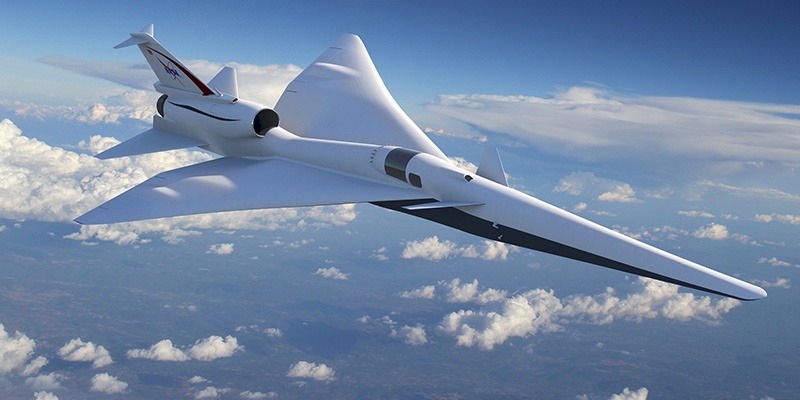
The X-59 is intended to address the noisy and frequently destructive sonic boom that has hampered high-speed air travel for almost 50 years. NASA hopes to replace the boom with a soft “sonic thump” using its creative design and state-of-the-art technology, opening the door for a new age of efficient, safe, and silent supersonic passenger flights over land.
A Significant Advancement in Supersonic Aviation
The X-59 has entered one of the last stages before flight testing, according to a recent confirmation from NASA. The aircraft is currently undergoing extensive system checks, engine integration, and final verifications at Lockheed Martin’s Skunk Works facility—a team famed for producing some of the most cutting-edge aircraft in the world—after years of engineering, sophisticated simulations, and structural assembly.
With this milestone, the jet is now closer than ever to its first flight, which is anticipated after all performance and safety reviews are finished. Additionally, it is a step forward for NASA as well as the international aviation sector, which has been looking for a workable solution to the sonic boom problem.
The Sonic Boom Issue: Why the X-59 Is Important
Strong pressure waves are produced when an airplane breaches the sound barrier, which is approximately 1,235 km/h or 767 mph. These waves combine to form a potent sonic boom. These booms may:
Damage buildings, particularly windows

Unsettle communities

Restrict supersonic travel to maritime routes.
In the 1970s, commercial supersonic flights over land were outlawed in the US and many other nations due to these problems. The world-famous supersonic passenger airplane, the Concorde, was unable to fully function on numerous routes because of this.
NASA’s objective with the X-59 is to reduce the boom to a soft thud in order to make supersonic flying over land tolerable. Global flight times might be halved in the future if they are effective.
NASA’s Strategy to Quit the Boom
The X-59 is a floating laboratory designed to change people’s perceptions of speed, not just another aircraft. This is made feasible by many crucial design decisions:
1. A Narrow, Long Nose
The jet’s exceptionally large nose, which is about 38 feet long, regulates the formation of shockwaves. They are softened and spread out rather than building up into a thunderous boom.
2. Positioning the Engine at the Top
The aircraft is equipped with a single General Electric F414 engine. This directs sound away from inhabited areas and helps protect the earth from engine noise.
3. Sonic Signature Shape
NASA has developed a precise airplane form that more smoothly handles pressure waves through years of wind-tunnel testing and computer simulation.
4. Pilots Do Not Have a Front Window
NASA eliminated the conventional cockpit glass in order to preserve the aircraft’s streamlined design. The eXternal Vision System (XVS), a set of high-resolution cameras and monitors that offer a real-time front vision, is what pilots use instead.
Together, these characteristics decrease the sonic boom to what NASA refers to as a “sonic thump,” which is likened to the sound of a car door shutting.
The Next Stage: Examining American Communities
The aircraft will go on an ambitious mission to gather human reaction data by flying over many U.S. cities once NASA completes test flights at Edwards Air Force Base.
Locals in particular locations will be questioned:
What was the volume of the noise?

Did it affect day-to-day activities?

Would they put up with this kind of loudness on subsequent flights?
The Federal Aviation Administration (FAA) and other foreign regulators will thereafter get this data. Regulations that presently forbid supersonic aircraft over land are to be updated.
If successful, manufacturers and airlines may start creating silent, supersonic passenger planes for use on commercial flights—something the world has never seen before.
Quiet Supersonic Jets’ Possible Advantages
Quiet supersonic flight would have a huge impact:
Quicker International Travel
Currently 10–12-hour flights might be shortened to 5–6 hours. This implies:
London to New York in less than four hours

Tokyo to Dubai in around six hours

Sydney to Los Angeles in eight hours as opposed to fifteen
Growth in Business and Tourism
Reduced travel times would increase tourism, provide new routes, and enhance commercial connections.
Improvements in Efficiency and the Environment
NASA’s research contributes to improvements even if supersonic planes consume more fuel:
Efficiency of energy

Technologies for clean engines

Superior aerodynamics
Numerous upcoming aircraft designs may profit from these developments.
Problems That Still Need to Be Solved
Despite significant advancements, the X-59 project still confronts certain obstacles:
It might take years for regulatory clearances.

For commercial viability, fuel economy needs to increase.

For premium high-speed services, airlines will require new revenue models.

It is necessary to gauge public approval of even a diminished "thump."
However, NASA thinks these difficulties are doable and worthwhile.
In conclusion, a new supersonic era is imminent
NASA has made significant progress in addressing one of aviation’s most significant constraints with the X-59. The airplane represents the next phase of human movement and is more than simply an engineering marvel.
If the X-59 is successful, it will pave the way for silent, swift, and effective supersonic flight throughout the world, making long-distance travel easier, faster, and more environmentally and socially friendly.
The world is watching as NASA moves on with its flying testing. Once considered to be unattainable, the ideal of silent supersonic flying is now closer than ever.


